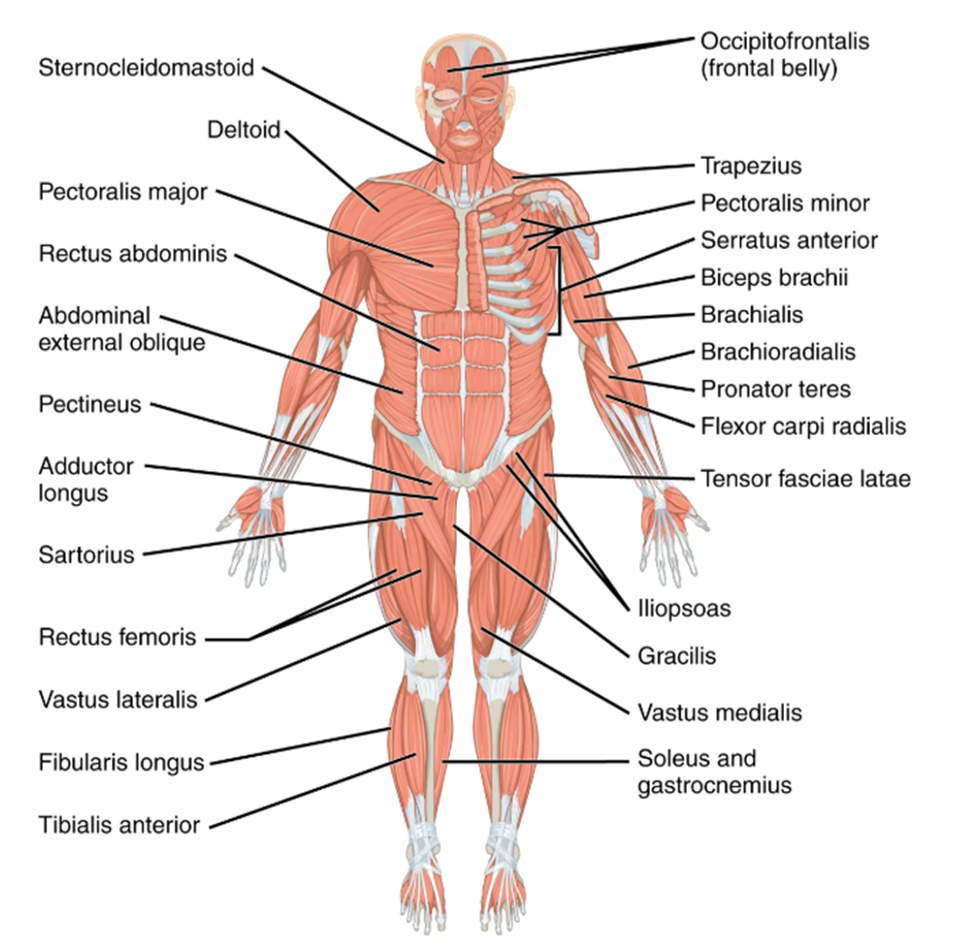
Case Overview:
A 56‑year‑old man spent a weekend painting and hanging wallpaper in his home. He worked for long periods with his arms raised above his head. Afterward, he noticed increasing pain in his right shoulder, especially when lifting his arm.
During an assessment, several muscles were tested for strength:
Muscles Showing Reduced Strength
Muscles with Normal Strength
Muscles Involved in Scapular (Shoulder Blade) Movement
To better understand his shoulder problem, the muscles that control the movement and position of the scapula (shoulder blade) were examined:
The upward‑rotation muscles were the weakest group in this case.
Muscle Tightness Found
Summary of the Movement Issue
Because certain muscles that help rotate and stabilize the scapula were weak—especially the serratus anterior and lower trapezius—the shoulder blade was not rotating upward normally. Combined with tightness in the pectoralis minor, the space underneath the acromion (the top part of the shoulder blade) became smaller.
This can cause the supraspinatus tendon (one of the rotator cuff muscles) to become compressed when lifting the arm, leading to pain.
1. Assign the letters (A–M) to the corresponding muscles of the shoulder, thorax, and abdomen shown below.
-
Latissimus dorsi
-
Trapezius
-
Rhomboid major
-
Internal oblique
-
Serratus anterior
-
Pectoralis minor
-
External oblique
-
Transversus abdominis
-
Rectus abdominis
-
Deltoid
-
Teres major
-
Pectoralis major
-
Infraspinatus
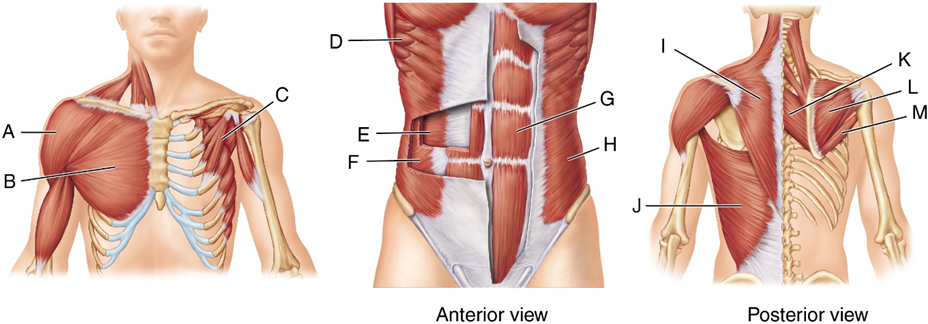
2. Assign the letters A–M from the previous item to each muscle action.
-
Prime mover of arm abduction; common site for intramuscular injection
-
Stabilizes, elevates, retracts, and rotates the scapula
-
Flex and rotate the lumbar region of the vertebral column
-
Stabilizes the scapula; roughly diamond shaped
-
Adducts and medially rotates the arm
-
Prime mover of arm extension
-
With ribs fixed, pulls the scapula forward and downward
-
Rotates the scapula so its inferior angle moves laterally and upward; the “boxer’s muscle”
-
Flex the vertebral column and compress the abdominal wall when the pair contract together; fibers run downward and medially
-
Flex the vertebral column and compress the abdominal wall when the pair contract together; fibers run upward and medially
-
Compresses the abdominal contents; fibers run horizontally
-
Extends, medially rotates, and adducts the arm
-
Rotates the arm laterally
3. Identify the muscles indicated by the letters below.
A. _______________
B. _______________
C. _______________
D. _______________
E. _______________
F. _______________
G. _______________
H. _______________
I. _______________
J. _______________