
Commander’s Intent and Planning Guidance Refresher
https://www.youtube.com/watch?v=g3YiPC91QUk (1:47)
Commander’s Intent
-
Succinctly describes what constitutes success for the operation. It includes the operation’s purpose, key tasks, and the conditions that define the end state.
-
Purpose – addresses the broader purpose of the operation and its relationship to the force as a whole. It does not restate the “why” of the mission statement. Tip: Look at the mission statement two level up as a start point
-
Key Tasks – activities (conditions/effects) the force must perform as a whole in order to achieve the end state.
-
End State – desired conditions at the conclusion of the operation described in terms of friendly forces in relationship to conditions of the enemy, terrain, and civilian considerations.
-
-
Must be easy to remember and clearly understood by leaders and Soldiers two echelons lower.
Breaking the Intent Down
-
Broader Purpose.
-
It is NOT your mission purpose.
-
Look at the purpose for higher echelons.
-
Ask yourself, “What is the overarching purpose of why we are here?”.
-
-
Key Tasks
-
Not COA dependent!
-
Not a specified task for one subordinate unit
-
Actions/effects we must accomplish to meet the end state
-
An effect we have on the enemy
-
Terrain we must control
-
-
Endstate
-
A narrative that describes what 25th ID (in this case) looks like in relation to enemy, terrain, and civilian populace once the fight is concluded (in this case the defense).
-
-
Technique. Formulate your your broader purpose first, then your endstate. Look at these and figure our what the division must do to “bridge” the gap.
CDR’s Intent from Mojave Maneuvers
(U) Purpose. The purpose of this operation is to prevent O-SMT from gaining access to the I-40 and I-15 corridors.
(U) Key Tasks. 1) Identify the 71 ACG first tier battle positions to disrupt the continuity of their defense inside main battle zone; 2) Interdict 71 ACG reserves to prevent reinforcement of the battle zone; and 3) Forward position sustainment nodes to allow 25ID to maintain momentum throughout the duration of the operation.
(U) End State. At end state, 715 BCG forces withdraw south of OBJ HAMILTON (11SNU 0985 0503) and OBJ MONROE, and 25ID defends along PL BLUE and is prepared to consolidate gains.
(Remember, this was an offense)
What the Rubric Says
-
Purpose statement clarifies relationships, focuses operations, and accomplishes higher HQ mission.
-
Key tasks are limited to tasks critical to achieve the end state and stated purpose of the operation. Enables staff initiative for developing courses of action; tasks do not lead the staff to a particular course of action.
-
End state clearly states a vision of the conditions that, when achieved, accomplish the mission; applies to all possible courses of action; clearly articulates the relationship between friendly and enemy forces, terrain, and civil considerations.
• Estes: Critical Infrastructure and limiting casualties
Planning Guidance
-
Commander does this at least four times:
-
First is initial. That comes during Step 1 and you have it.
-
Third comes after COA Development and refines COAs
-
Fourth comes after COA Approval and provides last minute adjustments
-
SECOND time is important and follows MA Brief (the one you are going to do)
-
-
Guidance after MA sets conditions for COA Development
-
The initial planning guidance outlines an operational approach which is a broad description of the mission, operational concepts, tasks, and actions required to accomplish it.
-
May outline specific COAs the commander directs the staff to analyze, or it identifies COAs the commander will not accept.
-
Allows the staff to develop several COAs without wasting effort on things that the commander will not consider.
-
Reflects how the commander sees the operation unfolding.
-
Describes when, where, and how the commander intends to employ combat power to accomplish the mission within the higher echelon commander’s intent.
-
-
See Page 5-22 of FM 5-0 for some examples. These are generic!
-
Make sure what you write applies to the 25th ID in the defense against the 715 165, and maybe 164 BCGs
-
Don’t give priority of fires to a specific unit…you don’t know who they are at this point. You can say “Advance Guard”, “Main Effort in Phase 2”, etc
-
Make sure it applies to the applicable WfF!
|
Command and Control |
Commander’s intent Course of action development guidance Number of courses of action to consider or not consider Phasing considerations Operational framework considerations Commander’s critical information requirements Critical events Task organization Rules of engagement Risk acceptance guidance |
Planning and operational guidance timeline Type of order and rehearsal Branches and sequels Commander’s location Succession of command Command post positioning, survivability, and displacement Liaison officer guidance Communications guidance Civil affairs operations Emission control and status Requests for information |
|
Intelligence |
Information collection guidance Information gaps Most likely and most dangerous enemy courses of action |
Scheme of intelligence Critical terrain and weather factors Critical local environment and civil considerations Intelligence focus during phased operations |
|
Movement and Maneuver |
Task and purpose of maneuver units Scheme of maneuver including forms of maneuver Reserve composition, priorities, and control measures Passage of lines Reconnaissance and surveillance |
Tactical deception Friendly decision points Information collection direction Collateral damage or civilian casualties Any condition that affects achievement of end state Mobility and countermobility |
|
Fires |
Priority of fires Synchronization and focus of fires with maneuver High-value targets High-payoff targets Special munitions guidance Target acquisition zones Observer plan Air and missile defense positioning Task and purpose of fires |
Scheme of fires Suppression of enemy air defenses Fire support coordination measures Attack guidance No strike list Restricted target list Information operations Cyberspace electromagnetic activities and electromagnetic warfare Desired enemy perception of friendly forces Initial themes and messages |
|
Protection |
Protection priorities Scheme of protection development Priorities for survivability assets Air and missile defense positioning Operations security Terrain and weather factors Intelligence focus and limitations for security Protected persons and places Anti-fratricide measures and friendly force recognition Personnel recovery Detention operations |
Protection and control of civilians Vehicle and equipment safety or security constraints Environmental considerations Unexploded ordnance Acceptable risk and risk management Escalation of force and nonlethal weapons Counterintelligence Chemical, biological, radiological, nuclear, and explosives guidance Force health protection measures Cyberspace network protection measures |
|
Sustainment |
Sustainment priorities Health service support Sustainment of detention and dislocated civilian operations Controlled supply rates |
Construction and provision of facilities and installations Detainee movement Anticipated requirements of Classes III, IV, and V |
-
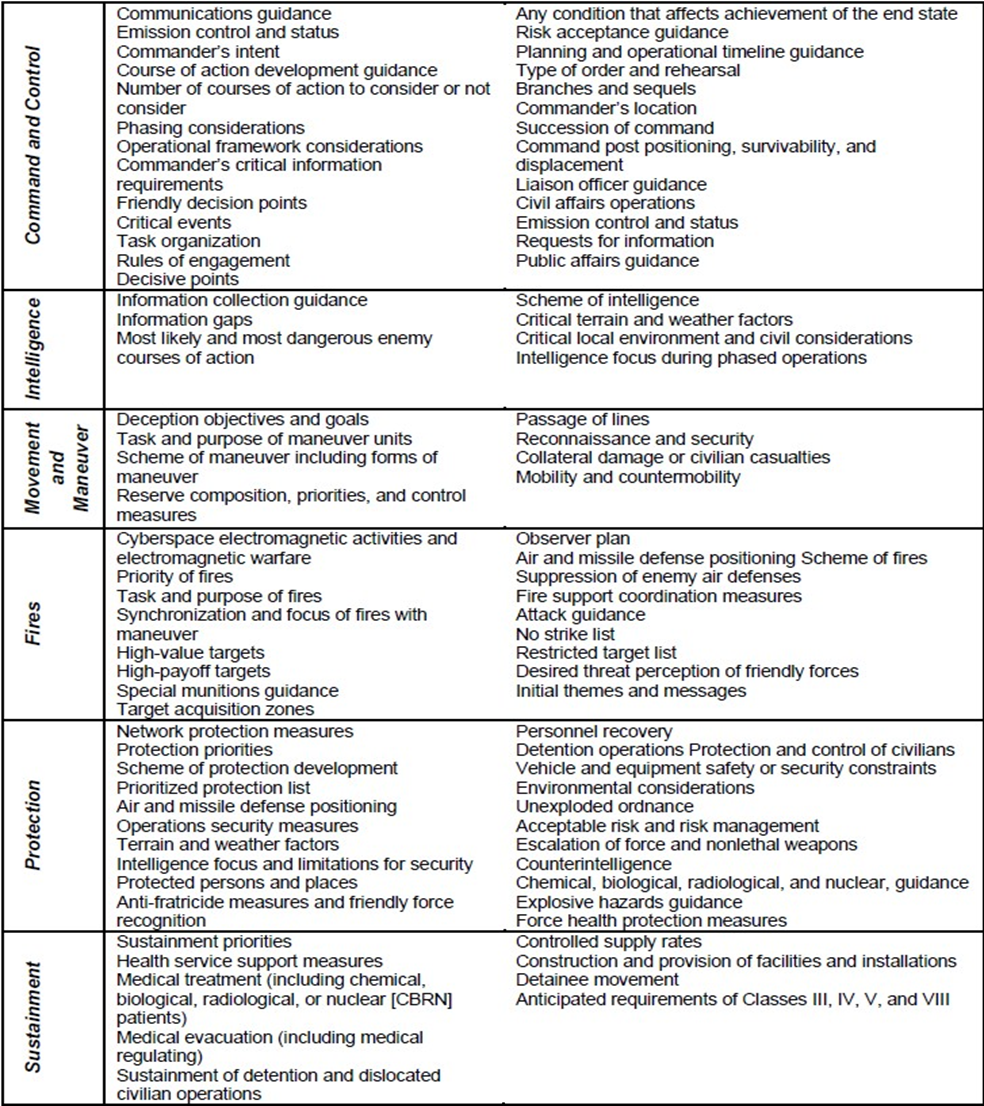
Guidance to the staff based upon the commander’s visualization for the development of COAs and orders.
-
Conveys the commander’s operational approach and reflects how the commander sees the operation unfolding.
-
Describes when, where, and how a commander intends to employ combat power.
-
Guidance is often broken out by warfighting function but may also include elements of operational art and aspects of operational frameworks.
|
Elements of Operational Art |
|
• End state and conditions
• Center of gravity
• Decisive points
• Lines of operations and lines of effort
• Operational reach
• Basing
• Tempo
• Phasing and transitions
• Culmination
• Risk |
Doctrinal WfF Planning Guidance Considerations
What the Rubric Says
-
Somewhat vague: “Completely Describes…..” vs “Mostly Describes…..”
-
Everyone does Maneuver and C2. The third one is IAW the assignment I gave you in the email.
-
Again, you are the 2IS, not 1 Corps.
-
Think what you want the defense to look like
-
Where do we put the command posts
-
Can you break this defense down into distinct portions? POL, main defense, Ctr Attack?
-
How big a reserve?