
Assignment Details
Unit 1 - Individual Project (125 points)
Description
Assignment Instructions
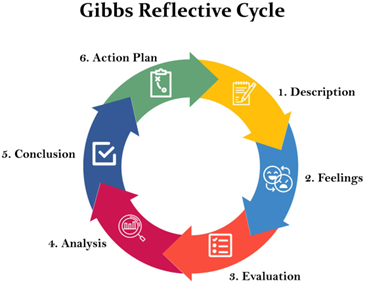
Read the description of the case study for this week. You are to approach each case study as though the situation actually occurred in your clinical practice. You will use the Gibbs Reflective Cycle to guide your analysis. You must respond to each phase of the Gibbs Cycle in sequence.
Each case study throughout the course targets different AACN domains in the initial scenarios so that all 10 domains are covered during the course.
You are then required to complete Phases 1–6 of the Gibbs Cycle for each case study and label the domain, competency, and concept that you demonstrate in the action plan. Please keep in mind that you should have demonstrated all domains, competencies, and concepts while completing all four case study action plans to potentially receive maximum points.
All domains (10), competencies (45), and concepts (8) can be found in the following link: Domains and Concepts.
Unit 1 Case Study
You are a Bachelor of Science in Nursing-prepared (BSN-prepared) nurse volunteering with a Florida disaster response team in the aftermath of a Category 3 hurricane that devastated a coastal city. You have been asked to lead a team because of your past emergency management services (EMS) leadership experience, although you are currently there functioning in your registered nurse (RN) role. You are assigned to a mobile health unit supported by an emergency health informatics system that allows for interoperability across electronic health record systems across the country. Other team members include the following:
-
A respiratory therapist
-
A social worker
-
A pharmacist
You are tasked with the following:
-
Triaging patients
-
Documenting care in an electronic disaster management system
-
Ensuring that care decisions are ethical and equitable
Power outages, random flooding, and mass displacement have left many residents and tourists without access to care. Those hospitals that are not affected by the disaster are at capacity and diverting patients because of limited resources. All of the policies and procedure are housed electronically for easy access.
During your shift, the following occur:
-
You notice injured undocumented immigrants avoiding treatment out of fear of deportation.
-
A generator fails, temporarily cutting off access to digital health records and communication with the central command. Unfortunately, the generator failure means that all policies and procedures are inaccessible as well.
-
You are asked to prioritize care for a public official over a low-income Asian older adult patient with multiple chronic conditions, raising ethical concerns.
-
You notice that there was no disaster policy for caring for the undocumented or uninsured population. Furthermore, despite having a Doctor of Medicine (MD) written protocol for dispensing antibiotics to individuals who met specific criteria, the pharmacist did not want to dispense antibiotics to any individual until the digital health record was back online and they could track their inventory. Consequently, many individuals who needed the antibiotics left without receiving them.
Do not alter the template. Please submit your assignment using the template. Complete the following:
1. Begin by restating the case study in full, using your own words to demonstrate comprehension and contextual understanding (as if you personally experienced the situation).
2. After completing Phase 1 (Description), continue with Phases 2–6 of the Gibbs Reflective Cycle. In addition to identifying the domain, competency, and concept in Question 1, you are also required to include these elements in Phase 6 (Action Plan), where applicable.
It is understood that not every competency may apply to Phases 1 or 6; however, by the end of the full analysis, all required domains and competencies from the rubric must be addressed.
Be sure to clearly label and explain the relevant AACN domain(s), competencies, and concepts demonstrated in your responses—especially within your Action Plan.
For assistance with your assignment, please use your textbook and all course resources.
Please submit your assignment.
Individual Project Rubric
The Individual Project (IP) Grading Rubric is a scoring tool that represents the performance expectations for the IP. This grading rubric is divided into components thatprovide a clear description of what should be included within each component of the IP. It is the road map that can help you in the development of your IP.
References
American Association of Colleges of Nursing. (2025). Domains & concepts. https://www.aacnnursing.org/essentials/tool-kit/domains-concepts
McLeod, S. (2025, March 26). Gibbs reflective cycle [Image]. Simply Psychology. Retrieved May 23, 2025, from https://www.simplypsychology .org/gibbs-reflective- cycle.html
NRSG 495: NURSING CAPSTONE & GIBBS REFLECTIVE CYCLE IP TEMPLATE
Name:
The student is required to complete 1–6 on the template, including the table in the template, based on their action plan. Review the rubric and example provided before completing.
1. Description (Refer to the case study provided each week and restate the case study in full, using your own words to demonstrate comprehension and contextual understanding [as if you personally experienced the situation].)
What happened?
List the domains that this initial case study description targeted; include the reason they apply. (Hint: List all domains listed on the grading rubric and review the example.)
List the competencies that this initial case study description targeted; include the reason they apply. (Hint: Review all of the competencies listed on the grading rubric and review the example.)
List the concepts that this initial case study description targeted; include the reason they apply. (Hint: Review the rubric and the example.)
2. Feelings (Reflect on how you would feel if the case study above happened.)
What were you thinking and feeling?
Reflection point: Recognizing emotional responses helps nurses become more empathetic and aware of how assumptions can impair effective care.
3. Evaluation (What went right, and what could be improved upon in the case study above?)
Discuss what was positive and negative about the experience.
4. Analysis (What is the root of the problem in the presented case study?)
What sense can you make of the situation?
5. Conclusion
What else could you have done?
6. Action Plan (This should be a comprehensive action plan based on reflection and the domains, competencies, and concepts learned in your program.) Note: After each action, list the domain and competency number in parentheses.
If it happened again, what would you do based on competent nursing practice (using the domains and competencies learned in your program)?
Domains, competencies, and concepts that your action plan targets (complete these based on your plan):
Each action plan should have a table (below) that outlines the competencies demonstrated under the domains, as well as the concepts demonstrated in the action plan. *Remember to include the competency numbers in the table.
|
Domain Name: 1: Knowledge for Nursing Practice
|
Domain Name: 2: Person-Centered Care
|
Domain Name: 3: Population Health
|
Domain Name: 4: Scholarship for the Nursing Discipline
|
Domain Name: 5: Quality and Safety
|
|
*Competencies (must be written out) |
*Competencies (must be written out) |
*Competencies (must be written out) |
*Competencies (must be written out) |
*Competencies (must be written out) |
|
|
|
. |
|
|
|
|
|
|
|
|
|
|
|
|
|
|
|
|
|
|
|
|
|
|
|
|
|
|
|
|
|
|
|
|
|
|
|
|
|
|
|
Concepts demonstrated in the action plan: (The eight possible concepts are clinical judgment; communication; compassionate care; diversity, equity, and inclusion [DEI]; ethics; evidence-based practice [EBP]; health policy; and social determinants of health [SDOH].) Select from the eight concepts all that apply to this case study.
|
||||
|
Domain Name: 6: Interprofessional Partnerships
|
Domain Name: 7: Systems-Based Practice
|
Domain Name: 8: Informatics and Health Care Technologies |
Domain Name: 9: Professionalism |
Domain Name: 10: Personal, Professional, and Leadership Development
|
|
Competencies (must be written out) |
Competencies (must be written out) |
Competencies (must be written out) |
Competencies (must be written out) |
Competencies (must be written out) |
|
|
|
|
|
|
|
|
|
|
|
|
|
|
|
|
|
|
|
|
|
|
|
|
|
|
|
|
|
|
|
|
|
|
|
|
|
|
|
|
|
|